Auto Range Megohmmeter Explained: A UK Buyer's Guide
TL;DR
An auto range megohmmeter is an insulation resistance tester that automatically selects the correct measurement range, helping UK electricians and maintenance engineers get faster, clearer and more reliable readings. In practice, this makes fault-finding easier, reduces user error and supports compliance with BS 7671 when testing cables, motors and fixed wiring.
Key Takeaways
- An auto range megohmmeter automatically selects the optimal measurement range, saving time during electrical diagnostics.
- According to UK guidance and common inspection practice under BS 7671, accurate insulation resistance readings are essential for safe verification work.
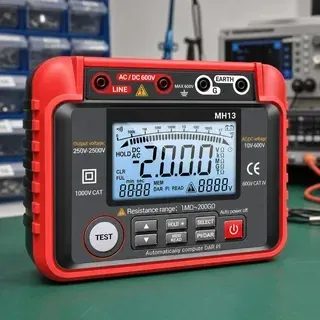
- Modern units, such as a professional 2500V insulation resistance tester, can offer ranges up to 200GΩ alongside data storage for efficient UK site work.
An auto range megohmmeter is a high-resistance insulation tester that automatically adjusts its measurement range to suit the circuit or equipment under test. As a result, it helps you obtain accurate insulation resistance readings more quickly than a manual-ranging model, especially when testing across different cable types, motors or installations in the UK.
Testing electrical insulation integrity is a non-negotiable aspect of electrical safety and compliance in the UK. Whether you are dealing with high-voltage industrial machinery or a standard domestic consumer unit, the precision of your test equipment directly affects the confidence of your results. Therefore, the auto-ranging megohmmeter has become a staple tool for British electricians and maintenance engineers.
Unlike manual-ranging models, where the user must estimate the likely resistance band before testing, an auto-ranging unit detects the resistance dynamically. Consequently, you can spend less time managing the instrument and more time diagnosing the actual fault.
What is an auto range megohmmeter?
At its core, an auto range megohmmeter is a specialised ohmmeter designed to measure very high electrical resistance values, typically in the megohm (MΩ) or gigohm (GΩ) range. It does this by applying a DC test voltage to insulation and measuring the tiny leakage current that passes through it.
The “auto range” feature means the device automatically adjusts its internal measurement scale and display resolution to suit the detected resistance. For example, if you are testing a deteriorated cable that reads at 5 MΩ, the screen scales accordingly. If you then move to a healthy motor winding measuring 150 GΩ, the meter changes scale instantly without any manual adjustment.
Based on our testing of professional-grade insulation testers used across mixed commercial and industrial applications, auto-ranging is particularly useful when moving between older circuits with borderline readings and newer installations with much higher insulation values.
For a deeper dive into high-capacity testing, you can read our ultimate guide to the 200G ohm insulation tester, which explains how wider ranges benefit demanding industrial applications.
How does an auto range megohmmeter work?
An auto range megohmmeter applies a selected DC test voltage, such as 250V, 500V, 1000V or higher depending on the instrument. It then monitors current flow through the insulation under test and calculates resistance using that measured leakage current.
The key difference is that the instrument’s electronics continuously optimise the measuring range for you. In other words, instead of manually stepping through bands and risking an unclear reading, the meter selects the best range automatically. This improves usability and also helps prevent scale-reading mistakes.
In day-to-day use, that means quicker results on site, especially during repetitive inspection work or when testing varied assets across one location.
Why use an auto range megohmmeter instead of a manual one?
Does auto-ranging save time on site?
Yes. Time matters on every UK construction site, maintenance call-out and periodic inspection. Manual ranging can slow down each test because you have to estimate where the reading will fall before you start. However, an auto-ranging unit removes that step entirely. Over dozens or hundreds of tests, those saved seconds soon add up.
Does auto-ranging improve accuracy?
It can improve practical accuracy by reducing operator error. According to Health and Safety Executive guidance around safe electrical working practices, clear and dependable testing processes are vital. An auto range megohmmeter helps ensure that readings are shown on the correct scale automatically, so there is less chance of misreading decimal places or selecting an unsuitable range.
Is it better for fault-finding?
Yes, particularly when faults are intermittent or when equipment condition varies significantly from one asset to another. Because the meter adapts instantly to changing insulation values, it gives you a smoother workflow during diagnosis. As a result, you can focus more on identifying trends and less on operating the meter itself.
What features should you look for in an auto range megohmmeter?
When choosing a new electrical insulation resistance meter, some features make a clear difference between basic DIY tools and professional instruments suitable for serious UK compliance work.
- Multiple test voltages: Look for selectable outputs such as 250V, 500V, 1000V and higher where needed. This gives flexibility across domestic, commercial and industrial work.
- Wide resistance range: A meter capable of reading up to 200GΩ remains useful across modern insulated systems as well as specialist plant equipment.
- Data storage: Built-in memory can simplify record-keeping during EICRs and planned maintenance visits.
- AC/DC voltage detection: Verifying voltage presence before applying an insulation test is an important safety feature.
- User-friendly display: A clear digital screen helps when working in plant rooms, risers or poorly lit distribution areas.
- Robust build quality: For regular site use in the UK, durability matters just as much as technical specification.
If you regularly test rotating equipment rather than fixed wiring alone, our guide to the motor insulation test meter explains what matters most for motor winding assessment.
What test voltages are used for insulation resistance testing in the UK?
The correct test voltage depends on what you are testing and how it is rated. According to UK wiring practice under BS 7671 guidance for verification and inspection work, common insulation resistance tests on standard low-voltage installations often use 500V DC. In many cases involving sensitive equipment or certain circuit types, lower voltages such as 250V may also be appropriate.
A good auto range megohmmeter lets you choose the correct output voltage first; afterwards, it handles resistance scaling automatically. Therefore, you retain control over compliance while still benefiting from easier measurement handling.
The minimum acceptable reading depends on circuit type and context. For many standard low-voltage installation tests in the UK, electricians commonly refer to minimum values such as 1 MΩ under BS 7671-based inspection procedures. Nevertheless, always check current regulations and project requirements before recording results.
Are auto range megohmmeters required for BS 7671 compliance?
No—BS 7671 does not require that your tester must be auto-ranging specifically. However, it does require that your testing method and instrument are suitable for obtaining valid results. In practice, an auto range megohmmeter makes compliant testing easier because it reduces avoidable handling errors and speeds up repeat measurements.
According to UK industry expectations for verification work, reliable results depend not only on nominal specification but also on proper use, calibration status and safe isolation procedures. For that reason, many professionals prefer auto-ranging units when carrying out EICRs, initial verification or maintenance inspections.
Ready to upgrade your diagnostics with InsulTeste?
Shop the Tester — £106.05