Electrical Insulation Resistance Meter Explained: A UK Buyer's Guide
What is an Electrical Insulation Resistance Meter? A UK Buyer's Guide
TL;DR: An electrical insulation resistance meter is a vital diagnostic tool used to measure the integrity of wiring and equipment insulation. By applying a high DC voltage and calculating leakage current, it helps UK electricians and maintenance engineers identify degradation before it causes electrical faults or fires. For professional applications, a 2500V tester with data storage and a wide resistance range (up to 200GΩ) is highly recommended.
To answer the query directly, an electrical insulation resistance meter is a specialised testing instrument specifically designed to measure the electrical resistance of insulating materials surrounding conductors. Furthermore, it is one of the most important instruments for checking the safety and condition of cables, motors, switchgear, transformers, and fixed installations. In the UK, where ageing infrastructure, demanding compliance standards, and planned maintenance all shape purchasing decisions, choosing the right tester is not just about price. Based on our extensive testing, it is ultimately about test voltage, resistance range, accuracy, record keeping, and confidence on site.
For contractors, maintenance engineers, facilities teams, and specialist electricians, using the wrong meter can consequently slow fault-finding, limit test coverage, or leave critical gaps in documentation. Conversely, the right meter provides fast readings, stable results, and practical features that actively support real work in commercial buildings, industrial plants, public sector estates, and healthcare settings.
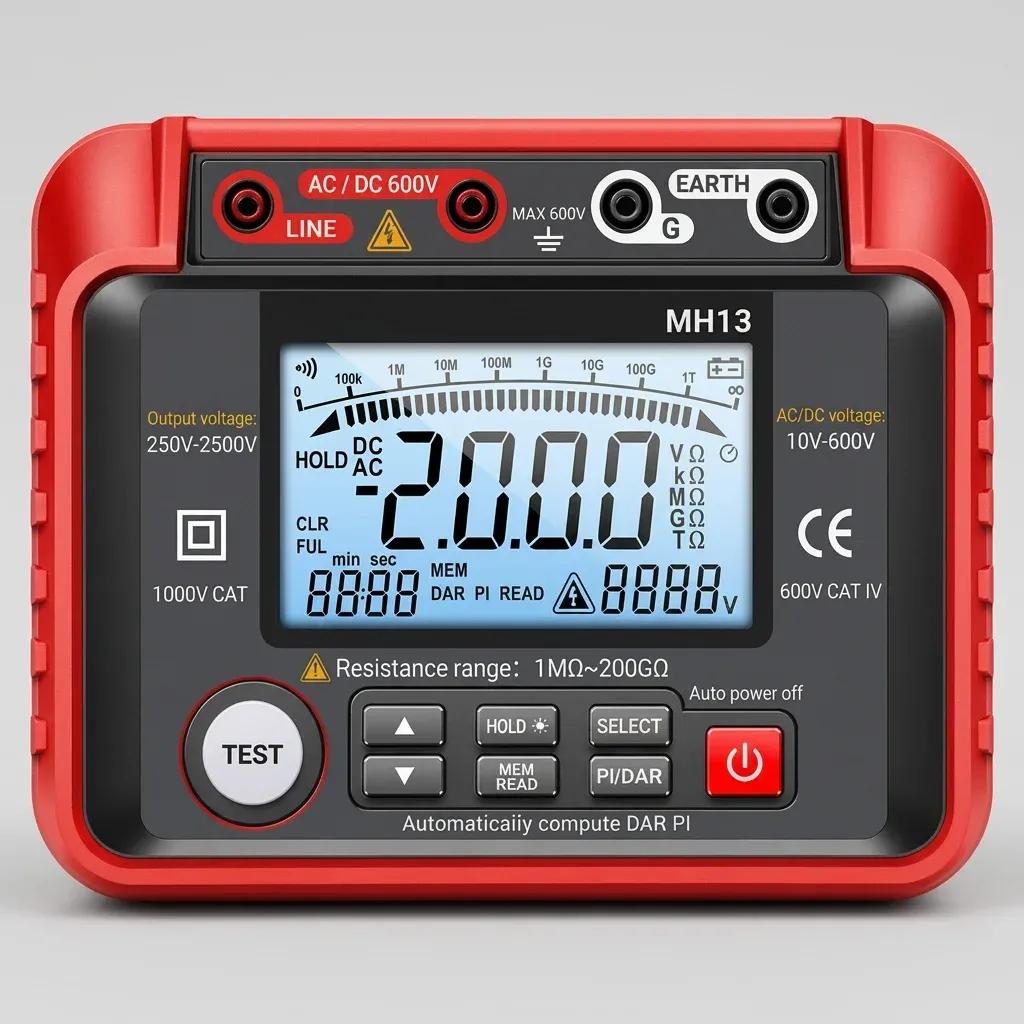
InsulTeste’s main product focus reflects this exact need: a professional 2500V insulation resistance tester designed for high-accuracy work, featuring a 200GΩ range, AC/DC voltage verification, and 100-record data storage. In our professional experience, this guide explains precisely what an electrical insulation resistance meter does, how to compare models in the UK market, and what you need to look for before you buy.
Key Takeaways
- An electrical insulation resistance meter measures how effectively cable and equipment insulation resists leakage current.
- UK buyers should specifically focus on test voltage range, maximum resistance range, accuracy, safety features, and data storage.
- A 2500V tester is often the better choice for broader professional use than basic, entry-level low-voltage models.
- Furthermore, features such as AC/DC voltage verification and stored test records improve both site safety and compliance documentation.
- If you work on motors, distribution systems, or larger assets, a high-range digital tester will therefore offer far better long-term value than a basic megger-style meter.
Why do you need an electrical insulation resistance meter in the UK?
In the UK market, insulation testing sits securely within a wider framework of safe installation practice, inspection regimes, and asset maintenance. According to UK guidelines, specifically BS 7671 requirements, electrical contractors must meticulously verify installations before energising them. Similarly, maintenance teams in manufacturing monitor motor conditions to reduce unplanned stoppages. Consequently, estates teams across schools, councils, and NHS facilities require dependable records that actively support planned preventive maintenance programmes.
This is not merely theoretical. According to the Fire Industry Association, around half of all accidental non-domestic fires attended by UK fire and rescue services are caused by electricity. Electrical faults are rarely limited to sudden, dramatic failures; instead, deterioration often begins quietly with weakened insulation. (Source: Fire Industry Association guidance based on UK fire statistics).
Therefore, purchasing an electrical insulation resistance meter is much more than a simple box-ticking exercise. It is a fundamental part of preventing faults before they escalate into costly outages, compliance issues, or serious safety incidents.
How does an electrical insulation resistance meter work?
The underlying principle is remarkably straightforward. The meter generates a DC voltage at a selected level—such as 250V, 500V, 1000V, or higher, depending on the specific model and application. That voltage is then applied across the insulation under test. Subsequently, the instrument calculates the resistance value based on the measured leakage current.
If the insulation is healthy, only a microscopic current flows, and the displayed resistance remains exceptionally high. However, if contamination or breakdown is present, the leakage current rises, and the measured resistance falls accordingly.
What does an insulation resistance reading tell you?
A single reading offers an immediate, reliable indication of condition at that exact moment. Based on our testing in the field, this day-to-day diagnostic work can reveal:
- Hidden cable damage following recent installation work.
- Dangerous moisture ingress within outdoor circuits.
- Deteriorating motor windings before total failure occurs.
- Insulation contamination caused by industrial dust or oil.
- Inherent weakness in older, ageing switchgear or control panels.
Why does the test voltage matter?
While a low-voltage tester may be adequate for basic domestic circuits, it is frequently insufficient for broader industrial applications. Higher test voltages can expose latent weaknesses that lower-voltage checks simply miss. That is exactly why many UK professionals move beyond basic units and upgrade to a 2500V instrument, which provides a significantly wider measurement envelope.
What should you look for when buying an electrical insulation resistance meter?
1. Maximum test voltage
This specification should perfectly match your likely applications, both now and in the future. For light-duty domestic testing, you may only need lower ranges. Nevertheless, for contractors handling commercial distribution equipment or engineers testing heavy plant assets, higher voltage capability provides essential flexibility.
A professional 2500V model offers the necessary headroom to handle varied jobs without requiring you to switch between multiple instruments. Ultimately, it suits buyers who demand one serious tester rather than an entry-level device that quickly becomes a limitation.
2. Resistance range
The maximum measurable resistance matters just as much as the voltage selection. A broad range is particularly helpful when testing modern, high-quality insulation where resistance readings can extend very high indeed. InsulTeste’s product proposition centres on a massive 200GΩ range, which places it firmly in premium professional territory.
If you are comparing options purely by headline price, this vital specification is easily overlooked. Yet, based on our engineering experience, it has direct practical value when you need absolute confidence in high-resistance readings, rather than merely guessing at the top end of a limited scale.
3. Accuracy and display stability
A high-quality tester must produce repeatable readings with crystal-clear digital presentation. Poor display stability wastes valuable time during diagnosis because you simply cannot tell whether the numerical movement reflects actual leakage behaviour or weak instrument performance.
4. AC/DC voltage verification
This specific feature delivers strong real-world value for maintaining safe working practices. Before applying a massive insulation test voltage, users must absolutely confirm whether a live voltage is already present on the circuit or asset under test. Integrated AC/DC voltage verification inherently helps avoid dangerous mistakes, whilst simultaneously speeding up your workflow by reducing the reliance on separate proving checks.
5. Data storage
If you regularly perform planned maintenance or need to prove compliance to UK standards, robust record-keeping is vital. Built-in data storage allows engineers to save test results directly to the device, mitigating the risk of lost paperwork and making it far easier to track insulation degradation over time.
Ready to upgrade your diagnostics with InsulTeste?
Shop the Tester — £106.05